

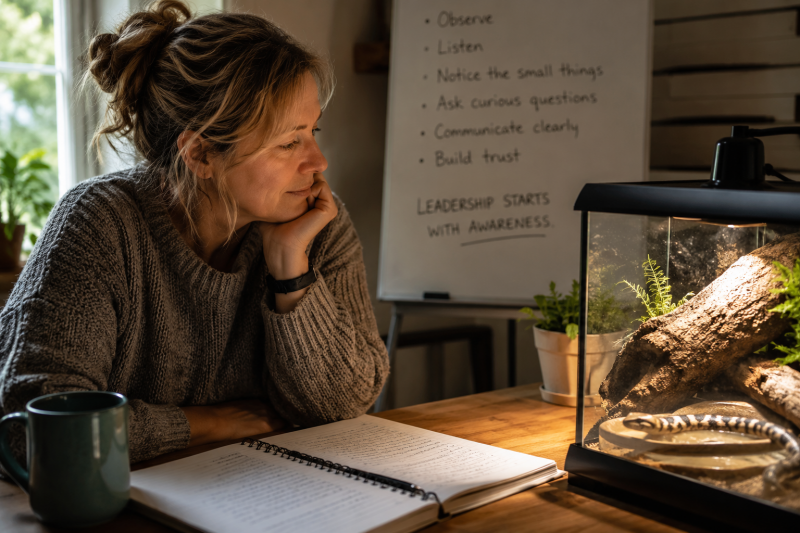
One of the things I love most...
...about working with animals is that they are constantly teaching us lessons about people.
Recently, while caring for a client's pets, I was reminded just how important observation can be—and equally, how dangerous assumptions can be.
As a house sitter, I receive detailed instructions about feeding routines, exercise, medications, and the many little quirks that make each pet unique. During this particular sit, there was a snake in the household.
On a previous occasion, I had been specifically told not to do anything with the snake. So when I arrived for this sit, I naturally assumed those arrangements remained the same.
During the week, I noticed that the water level appeared low. There was no sign of the snake all week, only the skin it was shedding. I considered contacting the owners to check whether the water needed topping up. However, I'd already contacted them regarding another pet and discovered the stick insects had sadly died before the booking began. Not wanting to cause unnecessary worry whilst they were enjoying their holiday, I decided not to raise the question.
When the owners returned, they kindly mentioned that the snake's water should have been replenished as it evaporates quickly under the heat lamp.
Nobody was upset. No harm was done.
But it got me thinking.
The Risk of Assumptions
Most mistakes - whether in pet care, business, or leadership - don't happen because people don't care.
They happen because people assume.
We assume things haven't changed.
We assume someone else knows.
We assume yesterday's instructions still apply today.
Often, those assumptions feel completely reasonable at the time.
Observation is a Leadership Skill
In my work as a leadership coach, I often tell leaders that observation is one of the most underrated skills they can develop.
The best leaders notice what others miss.
They spot changes in behaviour.
They recognise when someone is unusually quiet.
They pick up on small signs that a project is drifting off course.
They ask questions before problems become crises.
Animals teach exactly the same lesson.
A dog that suddenly becomes withdrawn.
A horse that seems slightly uncomfortable.
A snake whose water bowl is emptier than expected.
Small observations can reveal important information.
Observation Alone Isn't Enough
The experience also reminded me that observation without communication has limits.
You can notice something.
You can wonder about it.
You can even have a feeling that something may need attention.
But unless that observation is shared, checked, or clarified, uncertainty remains.
In leadership teams, this happens all the time.
Someone spots a risk but doesn't mention it.
Someone notices a customer concern but assumes somebody else is handling it.
Someone sees a problem developing but doesn't want to bother others unnecessarily.
The result is often avoidable confusion.
Curiosity Beats Assumption
One of the simplest habits we can develop—whether caring for pets or leading people—is curiosity.
Instead of assuming, ask.
Instead of guessing, clarify.
Instead of relying on what was true last time, confirm what is true today.
Questions are rarely a sign of weakness.
More often, they are a sign of care.
What Pets Continue to Teach Me
After years of leadership development, coaching, facilitation, and now also caring for other people's beloved pets, I continue to be fascinated by how similar the lessons can be.
Animals don't care about job titles.
They don't care about status.
They simply respond to what is happening in the moment.
They remind us to pay attention.
To observe carefully.
To communicate clearly.
And perhaps most importantly, to stay curious rather than making assumptions.
Sometimes the smallest observations lead to the biggest lessons.

About the Author
Amanda Clarke is the founder of Four Paws & Fortress and has spent more than 25 years helping individuals, teams, and organisations develop stronger leadership, communication, and self-awareness. Along the way, she's discovered that dogs, chickens, snakes, and people often teach remarkably similar lessons about observation, trust, and understanding behaviour.
Add comment
Comments